First tests with my last build of a tube regenerative receiver.
The original design is by Vladimir Novichkov (please look for thread "6AS6 regen, mk2" on http://theradioboard.com for a detailed description).
I opted for a simplified build (no varactor-based fine tuning, no tube-based AF amp, no AGC). Still, probably one of the ugliest buids ever seen :) Anyway, after some tweaking it's starting to work.
The global tuning range is about 3600 kHz to 10700 kHz.
Yes, I need a reduction drive for the "band spread" capacitor, otherwise it will drive me crazy very soon :)
The small card at the centre of my kitchen table is a small JFET-based audio preamplifier.
The hairy hand appering in the video is not King Kong's, it's mine 😁
As one of my summer projects, I decided to build a simple MW box loop antenna, just to put into practice the idea of making it using PVC cable ducts like the ones in the image below:
The construction was fairly simple, as documented shortly by the following series of images:
I used some PVC-specific glue to connect the various pieces together. The inductive section is made by 12 turns of AWG 14 electric wire, covering completely the 40 mm internal width of the PVC duct. The size of the square loop frame is 60 x 60 cm.
For the capacitive (tuning) section, I recycled a polyvaricon capacitor and a small fine tuning capacitor that I had salvaged from an old transistor receiver. They proven to perfectly fit the purpose of tuning the whole MW band. It was only necessary to add a small switch to put the two sections of the polyvaricon in parallel when tuning the lower end of the MW band. With the two sections of the capacitor in parallel, the lower limit of the tuning range reaches about 375 kHz.
When it came to perform some tests, I was not expecting any difficulties. I thought to use my XHDATA D-808 portable radio to verify how the MW reception would have improved by inductively coupling the internal ferrite rod of the radio with the box loop antenna.
Well, after several tests with different approaches, still I wasn't able to assess that the external antenna was behaving as expected. For example, I wasn't able to identify the typical, narrow peak in signal intensity that corresponds to the selective nature of this kind of antenna. On the contrary, there was a distinct, unexpected, narrow notch, along the tuning range, where the signal completely disappeared.
After some reasoning, I concluded that probably the XHDATA D-808 was too sensitive on its own to take advantage from coupling with such a box loop antenna. Probably the narrow notch that I was finding during tests was caused by overloading of the input stages of the radio when the antenna was tuned exactly to the received frequency.
So I decided to try with a little, very cheap, poorly sensitive pocket radio and finally things started to behave as expected, as documented in this short video clip:
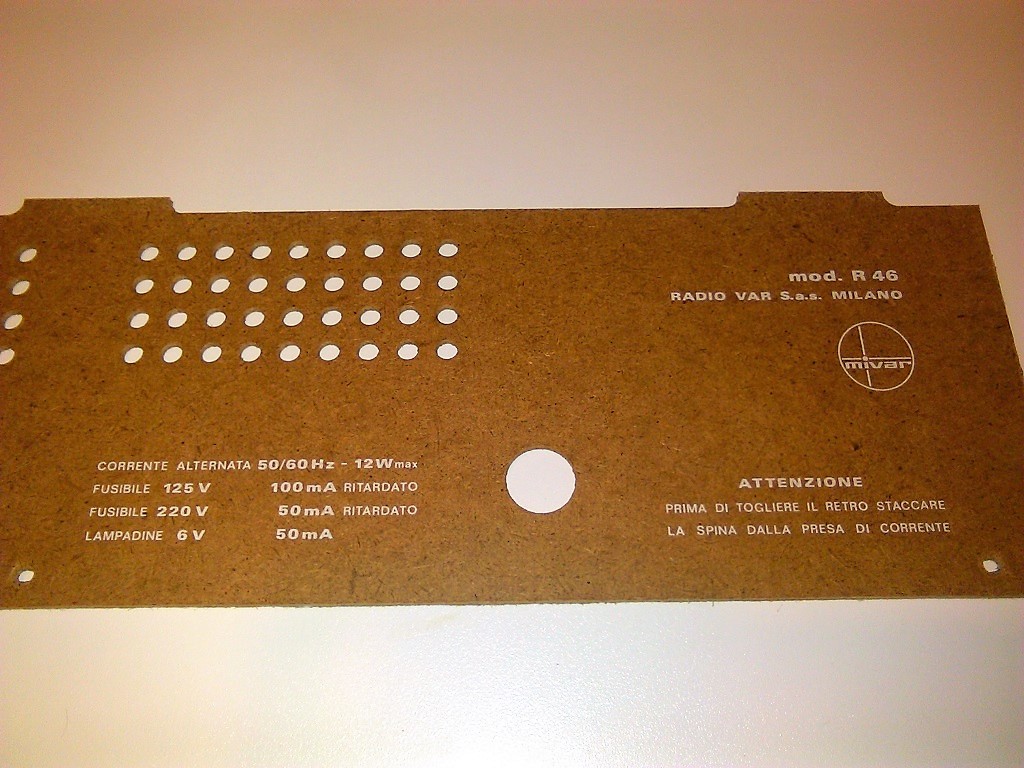
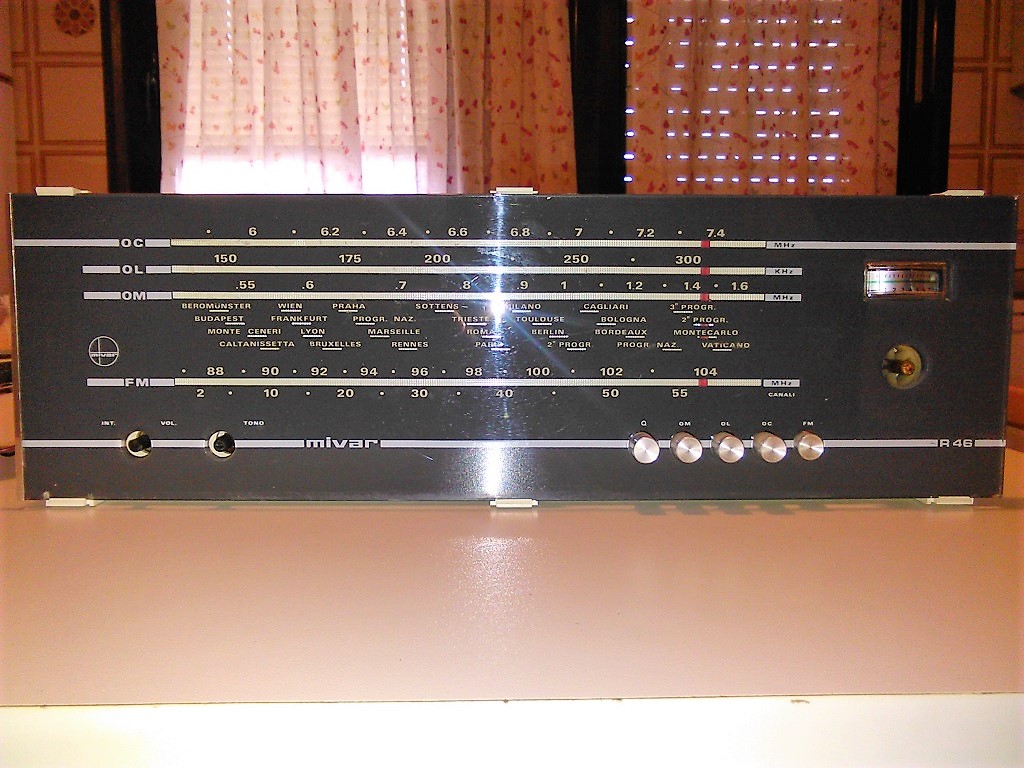
The Mivar R46 is a transistor-based radio receiver from early '70s. Mivar (Milano Vichi Apparecchi Radio) was an Italian firm founded by Mr. Carlo Vichi in 1945 (initially the brand was simply VAR). The company produced TV sets and radios until 2014, when it became clear that it was no longer possible to fight (in terms of cost reduction and R&D investments) against competitors from abroad that were too bigger than Mivar.
More about Mivar history at following link: Mivar - Wikipedia
The R46 t is a 60 cm long radio receiver with LW, MW, SW and FM bands. It has volume (AF gain) and tone controls. The tuning dial is wide and nicely backlighted by four 6 V, 50 mA (0,3 W) lamps behind it. A big tuning knob and the band switching push-buttons complete the set of controls on the front panel, which also features a very nice signal level meter near the top right corner, just above the tuning knob. The push-buttons include the "Fono" mode switch, which converts the unit in simply an audio amplifier. The input connector for this mode is on the rear of the radio, in the form of a DIN 5-pins plug which also hosts the output connection for a tape recorder.
Front panel of R46 (left side)
Front panel of R46 (right side)
Other connections on the back panel are: two antenna connections, one for the SW band and one for the FM band (LW and MW use the internal ferrite antenna) and a mains voltage selector (with options for 220VAC or 125VAC).
Externally, this old radio looks simple and solid, with a very clean and quite elegant design.
The same simplicity and cleanliness can be found once you start to dismount the receiver: three screws on the rear side to remove the back panel, four screws on the bottom to free the chassis from the enclosure, four screws to remove the loudspeaker from inside the unit. Pull out the three knobs from the front panel and you can easily extract the chassis together with the loudspeaker. Very fast and safe.
Rear panel of R46 (left side)
Rear panel of R46 (right side)
The loudspeaker
Loudspeaker removed
Also the tuning dial (which is made by glass) can be easily unlocked from the chassis.
The tuning dial of R46
Tuning dial removed
Two of the tuning dial lamps
The electronics as well looks well designed, with a very rational and clear layout of different sub-assemblies: the RF (antenna and tuning) section, the IF amplifiers, the power supply and AF amplifier. Each of the main sub-units is individually shielded and there is plenty of room to operate for repair or re-alignment.
The electronics of R46
The ferrite rod of the LW/MW antenna
The tuning capacitor, antenna and RF sections.
On the right side, the DIN connector for audio input (FONO) and output (TAPE)
The IF section on the left of the power supply and AF amplifier
Mains voltage selector on the power supply section. On the left, the IF subassembly
The bottom side of the power supply and AF amplifier section
The bottom side of the RF/IF section
The ferrite rod wich acts as the LW and MW antenna is notably long, which ensure good sensitivity. The aerial and oscillator coils are wound over plastic supports that can be easily moved along the rod to find the better position during RF alignment operations.
My unit came in good working order (apart from the probable need of a better alignment) so I decided to spend time only for some internal and external cleaning.
First, I had noticed that the volume potentiometer was soldered "quick and dirty", probably because of a replacement after a fault of the original device. So I started with trying to improve that point.
Before and after
Then I had to improve the functionality of the band switch push-bottons, which showed an intermittent behaviour (quite tipical for old radios), especially on the MW band. I used a spray contact cleaner and repeatedly operated the switches until they started to work fairly well.
For general cleaning of chassis and PCBs I used 99,9% isopropyl alcohol. I applied it with the help of a paintbrush and a toothbrush. I used compressed air both before (to remove dust) and after the cleaning (to remove any excess of alcohol).
There was a small piece of plastic that went detached from the chassis. I restored it in place with a drop of cyanoacrylate adhesive.
The tuning dial and the knobs what cleaned up with some warm water and just a bit of soap.
Finally, the wooden enclosure was treated with a specific oil, by first applying it with a paintbrush and then by polishing up the surface with a soft piece of cloth.
Here below you can see the results, which are pretty satisfying to me:
Recently I bought (from a well known on-line auctions web site) a nice sample of the ITT Schaub Lorenz Touring International model 103, an early 70's transistor radio.
When it finally came into my hands, I realized that the dial lamps did not light up as expected, when the radio was switched on while connected to AC mains.
The short video below is the little photo-story of how I had to gently disassemble the 103 to replace the broken lamp(s) with new ones. The second video is a sentimental tribute to this beautiful radio.