As a starting point, it is always quite important to decide what the power supply for the receiver will be. In my case, I already had a nice vintage Ameco PS-1 tube power supply that seemed almost perfect for this purpose. However, its internal circuit needed some improvements to be made more efficient; and the existing components (in particular, the old selenium rectifier and the electrolytic filter capacitor) needed to be replaced with something newer and safer.
 |
| The original schematic diagram of the Ameco PS-1 |
So I put toghether a rectifier bridge on a small piece of stripboard, made by four 1N4004 diodes (each in parallel with a 10 nF ceramic bypass capacitor) and I mounted it inside the power supply box, using the same screw that held the old selenium rectifier in place. Then I replaced the existing 2 x 22 uF, 150 V electrolytic capacitor with a new 100 uF, 400 V device. I removed the RC filter, as my intention is to add proper filtering where needed in the receiver.
The final schematic diagram of the power supply is the following:
 |
| The schematic diagram of my modified Ameco PS-1 |
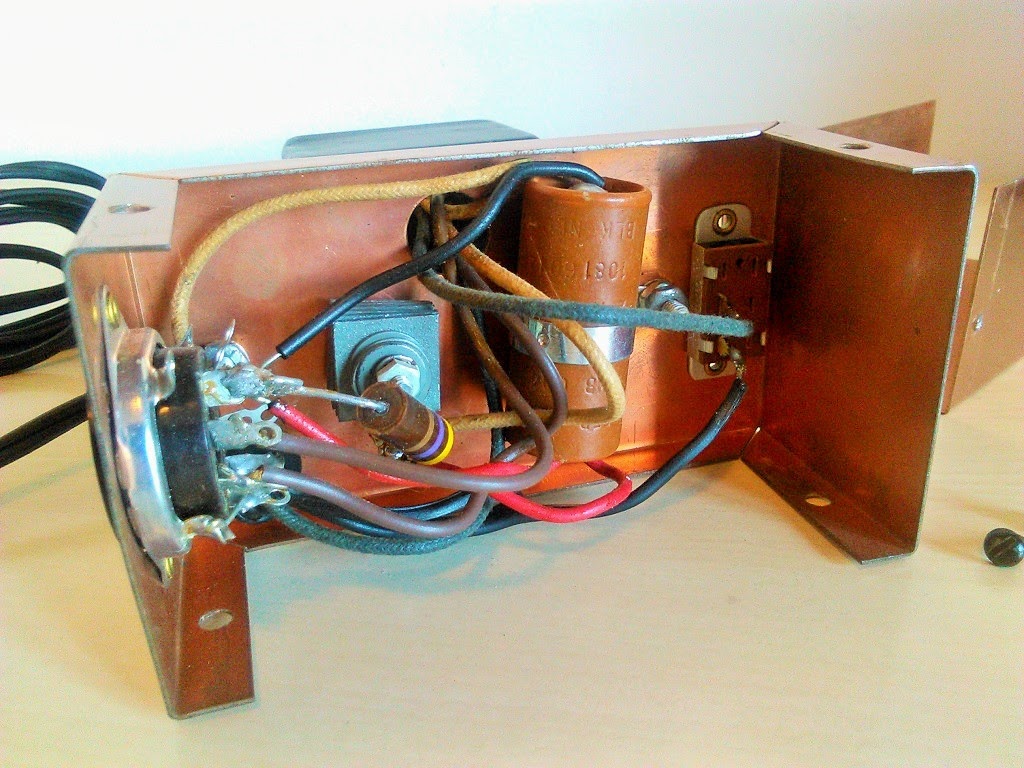
Here below a photograph showing the new internal wiring:

After having taken the image above, I added a 47 kohms, 1W bleeder resistor in parallel with the DC output.
For increased safety, I have also detached the so-called (in the Ameco PS-1 manual) "internal tie point" from pin 4 of the output connector (refer to figure below).
 |
| The modified output connector |
In fact, pin 4 of the output connector was simply used as a solder lug to connect one wire from the AC mains to one end of the primary winding of transformer. You can see it in the top right area of picture above.
To have the AC main voltage present on a pin of the output connector - labeled as a very generic "internal tie point" - was a bit dangerous in my opinion!
So I detached the AC mains wire and the transponder wire from the connector and I took the oppurtunity for inserting a fuse holder between them, with a 200 mA fuse.
I finally measured the output voltages (with no load) and found about 160 V DC on B+ and about 6.5 V AC for heaters. When connected to the receiver, I suppose the B+ voltage could drop to around 140 V DC, which should be good for my project.